Best practice interview with the owners of inlingua Mexico City

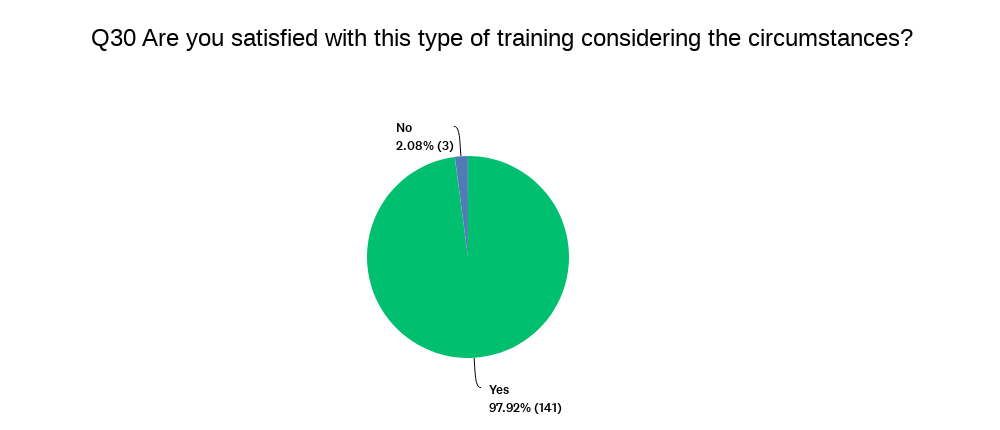
In our latest survey with learners on my.inlingua, 144 complete responses came from a single center: inlingua Mexico City. Of those 144 my.inlingua learners from Mexico City, nearly 98 % were satisfied with the training they received through Virtual Classroom and guided self-study on my.lab during the COVID-19-lockdown (see picture below).
We wanted to know, how inlingua Mexico City managed to reach such an outstanding degree of learner satisfaction. Read our best practice interview with Isabel Carranza Schulenburg and Leonardo Cortés Bertrand (Owners of inlingua Mexico City) to learn about best practices which can help you establish your center as a blended learning super power in your local market.

1. Your customers seem to be very satisfied with the remote training that they have received during the lockdown. How do you feel about such a high level of learner satisfaction and what is your interpretation of the survey results?

Of course, we are very proud of what the survey revealed about our work. When we opened our center in 2010, we decided to offer all our courses in a blended format.  Therefore, inlingua’s online learning platforms have been an integral part of our product mix ever since. About eight years ago, when the first inlingua Virtual Classroom platform became available, it was immediately integrated into our range of programs. Without knowing it, we have been preparing for such a situation for more than a decade. Thus, we are not entirely surprised about the positive result.

2. You mentioned your product mix, how do you integrate my.inlingua in the training you provide to your customers?

As we mentioned before, all the courses we offer are in a blended format. This means my.inlingua is part of every language course which we sell to customers. This was also the case before the pandemic. When we enroll a new learner, the learner automatically receives a my.inlingua account with my.lab access and the appropriate course assigned.  They are aware that one third of the course will be online. Our trainers and academic team constantly monitor the advancement and completion of the online course. Similarly, if a corporate client enrolls employees, the HR-representative of the client company automatically receives an account which allows him or her to monitor the progress of the enrolled employees.

3. To what degree is my.lab part of your courses?

Actual trainer led instruction makes up two thirds of the course and one third of any of our programs is guided online study on my.lab. This means that trainers establish clear goals for their learners or learner groups to which they assign tasks. The progress is closely monitored by our trainers. The learners and/or their employers are informed of the my.lab completion, especially if they are behind, on a monthly basis. Corporate clients take my.lab fulfillment as seriously as attendance in face-to-face or remote sessions. Our recommendation is a minimum requirement of 80 to 85% my.lab completion for a corporate learner, in the same timeframe as the live course.

4. What has changed since the pandemic hit your country?

It feels like a lot has changed. But concerning our training, not much is different. Before the pandemic a smaller part of our training, about 10% was delivered through Virtual Classroom on my.inlingua. Since all of our learners already had a my.inlingua account, it was not very difficult to switch the remaining learners to Virtual Classroom as well. And that is where we are now; 100% of our usual number of classes are on Virtual Classroom— not much else has changed.

5. You received a flattering amount of positive feedback form learners1. How do you ensure that trainers deliver high quality language training online?

We know that it really comes down to the trainers. In this profession, employee fluctuation is traditionally high. Having that in mind, we originally implemented a sophisticated circular process, managing all aspects of hiring, training, developing, coaching and re-employing trainers if they want to come back after a leave. We have a specific development plan for every freelance trainer working for us. Thereby we ensure that our trainers are 100% familiar with the inlingua method, material, and e-learning technology.

We now have mandatory weekly trainer development sessions. They are continuous training sessions, where we can remind trainers of important methodical aspects, further develop their training skills and encourage group discussions on pedagogical best practices. During these sessions, our academic team also makes sure that our teaching staff is kept motivated and focused on their tasks.

1 Two of many positive answers to open ended questions in the 2020 my.inlingua user survey conducted by inlingua International and evaluated for inlingua Mexico City:

“You have great instructors with an excellent competence and knowledge”

“I really appreciate the compromise and the effort that teachers make with this kind of teaching, I don’t feel a real difference between online classes and traditional classes, even when I’m a more traditional person.”

Where does your center excel? Contact service@inlingua.com if you want to share your best practices with the inlingua network.

The global pandemic caused by the COVID-19 virus has triggered a surge in digitalization, which also affects language learning. The term e-learning is suddenly on everyone’s lips. Now as we return once more to a semblance of normality, it remains to be seen how much of these new habits will remain after the crisis. Many language learners (and trainers) are looking forward to resuming face-to-face teaching in the familiar environment of the language center.

However, it can already be said with certainty that in the future so-called "blended learning" will become even more important. But what exactly is blended learning and what are the benefits both for learners and trainers? Blended learning is an approach to education that combines online educational material and interaction with traditional trainer led, place-based classroom methods. Blended learning has existed for many years in a wide variety of forms and manifestations and there are always discussions among educators as to what exactly is meant by it.

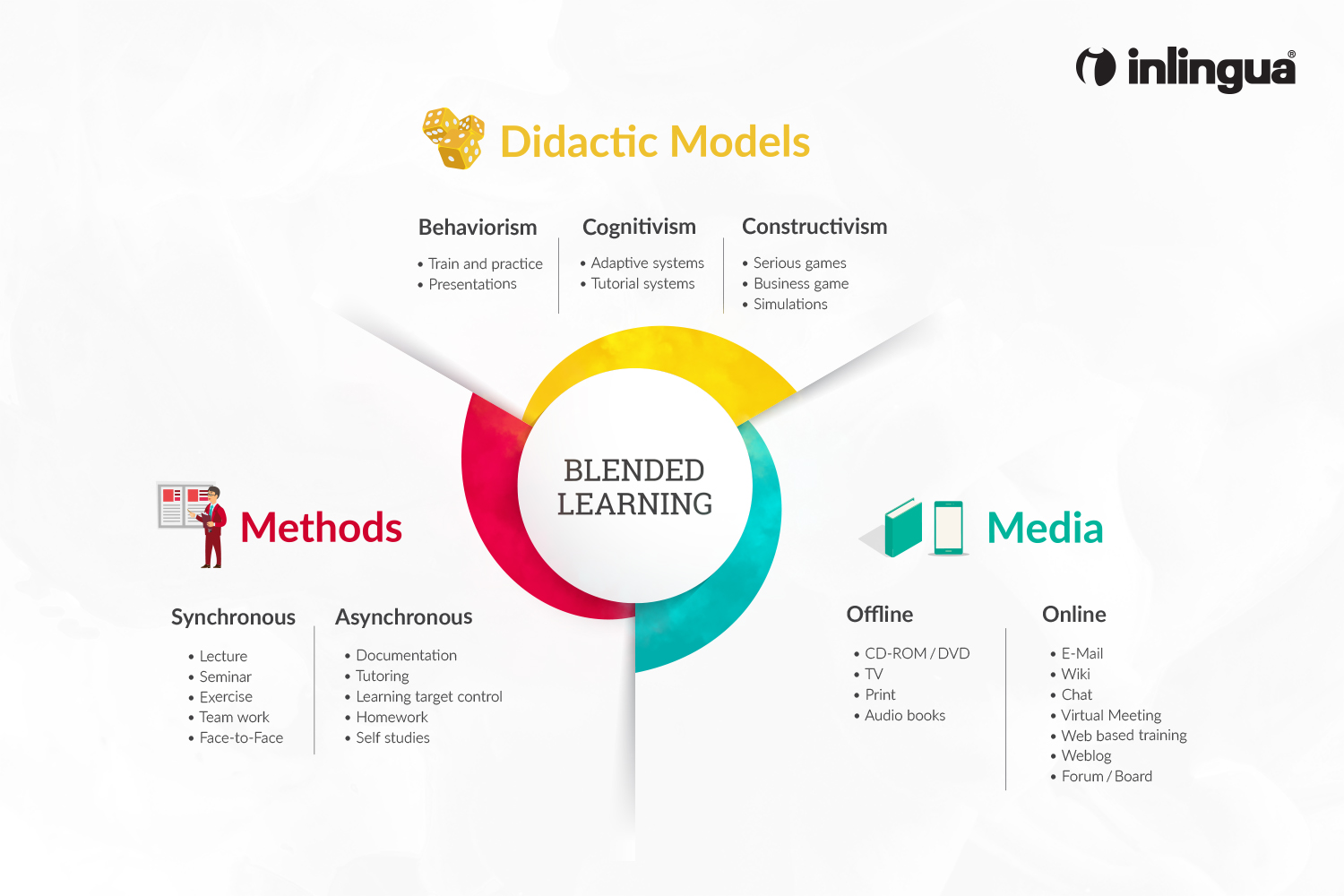
Claudia Wiepcke brought light into the darkness back in 2006 with her comprehensive overview, showing different aspects of didactic models, methods and media. A supplement and update were both provided in 2015 by Stefan Bieletzke.

Based on Claudia Wiepcke (2006) and Stefan Bieletzke (2015)

In blended learning scenarios, three forms of activity can be distinguished or combined with one another (cf. Alonso, López, Manrique & Viñes, 2007):

  • Self-directed e-learning: This is a setting, where learners can determine the time, intervals, pace and location of their learning activities themselves (“learning anytime and anywhere”).
  • Live e-learning: Synchronous forms of e-learning, for example lectures as webcasts or working in a virtual classroom at a fixed time. This enables learners to ask questions to the lecturers in real time or to exchange information with other course participants.
  • Traditional face-to-face teaching: Lectures, seminars, exercises, discussions and exchanges take place in the lecture hall, laboratory or seminar room and open up face-to-face interactions with teachers and fellow students.

There is disagreement about how much or how little online teaching belongs in the blend. Various authors agree that the percentage of online/offline content is not as important as the pedagogical design, timing and sequencing of activities to create a cohesive learning experience (Dziuban, Moskal & Hartman, 2005).

Thanks to a balanced mix of online and offline training, it is possible to take advantage of both methodologies, among which the following stand out:

Benefits for learners:

  • Blended learning offers the learner convenience and flexibility; they have the ability to control their learning pace and learn remotely.
  • Academic research suggests that through the use of more diverse means of information, blended learning gives learners a more comprehensive understanding of the course content.
  • Because blended learning allows learners to interact with instructors and fellow learners, social learning is supported.

Benefits for organizations:

  • Blended learning reduces face-to-face training costs, such as travel, accommodation, and printed training materials.
  • Companies can use varying eLearning methods, such as virtual classroom, online learning in LMS systems, gamification, etc., which result in increased learner engagement.
  • Because blended learning is a more efficient and cost-effective way to train, you’ll see a quicker and greater return on investment.
  • It’s also easier to track exactly who has, or hasn’t, completed training

Blended learning pitfalls:

Now that you know what blended learning is and we have piqued your curiosity, we would like to address some hurdles that need to be considered.

  • The most important pitfall you’ll need to avoid is using an LMS that doesn’t meet your needs. You’ll need an LMS suitable for language training to manage and deliver your blended learning strategy, including the integration of webinar/video conferencing software.
  • Keep in mind that what works for in-person training may not necessarily work for online training. You should not automatically assume existing courses are ready for online distribution. Analyze who your learners are, identify what they need to know, review your course content, and use this analysis to formulate a blended learning strategy.
  • If switching from exclusive face-to-face learning, take your time when incorporating blended learning into your learning strategy. Starting slow not only enables you to assess what is and is not working from a content perspective, but also gives your learners time to adapt gradually to the blended learning concept.
  • Of course, it’s important that blended learning isn’t used just for the sake of it. Once you have identified your learning goals, you can think about how each goal could be achieved in an online and/or offline setting.

By Christian Scheidegger, Pedagogical Manager, inlingua International Ltd.

Please click here, to consult further sources in German.


inlingua Plus offers a powerful tool that works with a fully integrated ZOOM or Webex host setting for Virtual Classroom. A vast variety of interactive online activities match the individual needs of your learners. Would you like to know more? Click here.

Are you thinking about learning a new language? In this blog series, we would like to inspire you with interesting facts about different languages. Today, we will share the top 3 reasons why you should consider learning Spanish:

580+ Million Speakers

More than 580 million people speak Spanish, which is around 7.6% of the world’s population. Of these, 483 million are native Spanish speakers, making Spanish the second most widely spoken language in the world. Talking Spanish allows you to connect with people around the globe! Spanish is the (or one of the) official language(s) in Argentina, Bolivia, Chile, Colombia, Costa Rica, Cuba, Dominican Republic, Ecuador, El Salvador, Equatorial Guinea, Guatemala, Honduras, Mexico, Nicaragua, Panama, Paraguay, Peru, Puerto Rico, Spain, Uruguay and Venezuela. However, Spanish isn’t solely spoken in these countries. In the United States, over 41 million people speak Spanish at home.

Boosts Employment Prospects

Are you looking to move up the career ladder? Most of the time, you are competing for the same position with people demonstrating similar skills and backgrounds. Understanding another language can set you apart from other applicants. If a job opening comes down to candidates of equal experience and education but one is fluent in an additional language, she/he will most likely get the position. Speaking Spanish will make you the go-to person to help Spanish-speaking clients and thus more useful and valuable in the workplace.

Cultural Insights

Your ability to understand Spanish enables you to gain valuable insights into Hispanic culture. Imagine reading books of famous writers such as Gabriel García Márquez or Jorge Luis Borges in their original language: understanding Spanish allows you to enter a whole new world! Spain and Argentina are among the top 15 book producers in the world according to the International Publishers Association. There are also many famous Spanish-speaking singers around the world: Enrique Inglésias, Marc Anthony, Luis Miguel, Shakira, Ricky Martin,… You will be able to interpret and sing all their songs with confidence. Many famous dance-styles such as Tango, Flamenco and Merengue originated in Spanish-speaking countries. Even though dancing doesn’t need much talking, knowing Spanish will surely make it easier on the dance floor!

Spanish is a comparatively easy language to learn to speak. So what are you waiting for? Immerse yourself in a new world whilst staying at home!

Can we help you create your personal learning path? inlingua offers flexible e-learning options tailored to your needs. Contact your local center for more information.

Have you recently started with e-learning? Did you sign up for a Virtual Classroom course?  You may find that learning from home is different than attending lessons at a language school. However, with the right tricks & tools it can be a very flexible and efficient alternative. Our pedagogical experts share their top 5 tips to effectively learn from home:

Have a Designated Study Area

Decide which room you would like to use for studying. It is recommended that you select a comfortable space with natural light, where you can learn undisturbed. Sit in an upright position, roll your shoulders back and drop them down. Leave only the material you need on your desk to avoid distraction and increase productivity.

Create a Routine

Besides work and other commitments, it can be challenging to find time for language learning. Learning from home allows flexibility and no additional travel time is needed. Fix a time in your daily schedule when you want to learn a language. Setting aside dedicated study time each week, allows you to make constant progress and focus on your goals. Do you prefer to study in the morning? Or do you remember things best if you study right before you go to sleep? If you find it difficult to know how much time you should allocate to specific learning activities, you can always ask your trainer for advice!

Set Attainable Goals

Plan ahead – step by step. Whether it is your goal to pass a language exam, speak fluently or achieve a certain level, attainable goals help to stay focused and disciplined. Setting goals helps you to continuously improve your skills and thus achieve your long-term goal in an effective and motivating way. Your language trainer will help you define your personal goals.

Stay Motivated

Identify the reason why you decided to learn a new language or make progress. If you already know the reason, write it down and make it visible. Would you like to be fluent in English to rock your business meetings? Does your business want to enter a new market and a multilingual salesperson is needed? Or do you need to pass a language exam for University? Regardless of the reason, it is important to acknowledge it and remind yourself frequently about your motivation. Be proud of your progress and reward yourself for each intermediary target you reach. Announce your intentions to your classmates and trainers. A common goal helps!

Get the Right Tools

Following online language courses gets easier with the right tools. Would you rather have face-to-face lessons in a Virtual Classroom with the same trainer and classmates or work individually with an e-book? Or do you prefer interactive exercises on your smartphone which are tailored to your level? How about combining them? It’s your choice!

inlingua offers tailored online language learning, combining the traditional inlingua method with the latest e-learning technology. Interested? Learn more here.