Anyone who wants to learn a new language today has unlimited options — especially those of the digital variety. Apps such as Duolingo, Babbel, and LingQ promise flexible learning anytime, anywhere. But despite the hype, can these apps really lead to fluent communication?

Numerous scientific studies and experience in language teaching suggest that apps alone cannot lead to fluency. Apps can teach vocabulary and grammar but understanding and participating in a lively conversation — often remains untrained. This is exactly where language schools like inlingua show their strength.

How Effective are Language Learning Apps? A Look at the Research

A study published by Duolingo itself with 225 participants who learned Spanish or French exclusively through the app showed that in the end, they reached the intermediate level (measured by ACTFL) in reading, but only the novice level in listening comprehension. (duolingo-papers.s3.amazonaws.com)

The result shows that learning with apps can lead to progress in reading and partial understanding but falls short when it comes to full comprehension or speaking.

Furthermore, a systematic review of AI-based chatbots in English language teaching reveals that such tools can be a supportive supplement but “still need to be improved in terms of context and culture-specific discourse formation”. (Cambridge University Press & Assessment)

Another analysis in Studies in Second Language Acquisition emphasizes the role of conversation and interaction in language learning processes (“Interaction Hypothesis”). The exchange of dialogue is essential for developing language competence. (Cambridge University Press & Assessment)

Finally, research in the field of second language anxiety indicates that learners with higher levels of inhibition are less willing to engage in conversation – which is precisely why a supportive environment (e.g., with trainers) is necessary. (Cambridge University Press & Assessment)

Together, these studies show that apps have their place, but interaction, live correction, and communicative immersion remain indispensable.

Grammar Apps vs. Language Trainers: What are the Differences?

Language trainers/language schools

  • Individual feedback, error correction, courses tailored for learners needs
  • Real-time discussions, role-play, spontaneous dialogues

Emotional and motivational factor through interpersonal contact

Apps (Duolingo, Babbel, LingQ, etc.)

  • Focus on grammar drills, vocabulary training, short exercises
  • Users often practice alone, with automated feedback

Useful for repetition and self-study, but limited in terms of free communication

The difference lies less in the content than in the type of application: an app can provide structure, but language develops through exchange.

Why Conversation is Central at inlingua

At inlingua, one thing is clear: we don’t treat speaking as secondary—it’s the core. Grammar and vocabulary are embedded in dialogues, discussions, and everyday scenarios.

This is exactly where the inlingua method comes. Our method has consistently focused on communication for over five decades – and is now used in a revised, modern form. With the DICES model (Discover – Interact – Communicate – Evaluate – Solidify), learners go through five phases that lead from their first encounter with the language to confident use.

  • Discover: New content is introduced in realistic situations.
  • Interact: The language is actively used – in all skills, with a special focus on speaking and listening.
  • Communicate: Learners practice spontaneous communication in authentic contexts.
  • Evaluate: Feedback and reflection ensure conscious progress.
  • Solidify: What has been learned is anchored in a sustainable way – in a playful and practical manner.

This structure ensures that conversation is not just a practice area, but the actual goal: to be able to use the language actively. With the new NextGeneration materials and digital supplements such as my.SmartLearning, the method is further strengthened and adapted to the needs of modern learners.

Flexibility – no Longer the Sole Preserve of Apps

A key argument used by the app developers is their flexibility: you can learn whenever and wherever you want.

But modern language schools now offer this too:

  • Face-to-face lessons in small groups or one-to-one
  • Online training, live with trainers
  • Digital platforms (e.g., my.SmartLearning) as a supplement

This allows inlingua to design a flexible learning concept that adapts to your everyday life – without sacrificing the human factor.

Hybrid Learning: The Best of Both Worlds

The term “blended learning” refers to the combination of digital resources and face-to-face teaching. Numerous studies show that this model often leads to the best learning outcomes.

inlingua offers:

  • my.SmartLearning for self-directed practice of grammar and vocabulary
  • Live lessons for conversation, practice, and feedback
  • Symbiosis of digital flexibility and personal support

This allows learners to benefit from both structured training and lively exchange.

Orientation Instead of a Flood of Apps

Many people who want to learn a new language face a dilemma: too many apps, no clear choice. Time is often wasted trying things out.

A language school like inlingua offers structure, planning, and targeted support:

  • Individual learning plans
  • Support from experienced teachers
  • Continuous feedback and adjustment
  • Motivation through community and personal coaching

This saves time, reduces frustration, and leads to lasting progress – far beyond what many apps can achieve.

Conclusion: Apps as a Tool, not a Solution

Language apps have their place: they enable flexible practice and a low entry threshold. But language proficiency only develops through interaction — and an app is not enough for that.

Research clearly shows that interaction, conversation, and correction are essential for real learning success (Interaction Hypothesis) (Wikipedia), and inhibitions are reduced more quickly when speaking in a supportive environment (Cambridge University Press & Assessment)
inlingua consistently combines digital tools such as my.SmartLearning with dialogue and human support. This creates a lively, effective learning environment that goes far beyond pure app learning – exactly what really matters when learning a language.


Happy learning!

If you have been following our recent blog series, you will know we are about to launch a new series of EFL materials. With the release of the Next Generation materials, we are not simply updating our coursebooks, we are meeting the challenge to provide the material that is needed to learn English in a digital world.

Central to this new approach are two methodologies: blended learning and the flipped classroom. Together, these strategies reflect our belief that modern learners thrive best when given the flexibility, autonomy, and support to learn in ways that match their lives, while still benefiting from the human connection that defines inlingua training. 

Teaching in Tune with Today 

The traditional model of language teaching, where new content is introduced by the teacher in class, then practised independently at home, no longer matches the expectations of today’s learners. The flipped classroom turns this structure on its head: learners first engage with new content on their own, through digital materials, and class time is then dedicated to meaningful interaction and practice. Flipped learning has been found to have “a significant positive impact” on proficiency and research results “demonstrate the effectiveness of this approach over the traditional face-to-face approach.” 

Blended learning supports this model by combining in-person or virtual lessons with self-guided online activities, creating a seamlessly integrated learning experience. Learners benefit from flexibility and personalisation, while still being guided by experienced trainers who help bring the language to life.

At inlingua, this shift is not just theoretical. It is embedded into the very structure of our Next Generation courses. Our learners are introduced to vocabulary and grammar topics through my.lab and my.SmartLearning our AI-powered vocabulary trainer on our LMS my.inlingua. By the time they enter the classroom physically or virtually, they are ready to speak, interact, and apply what they’ve learnt. 

A Pedagogical Framework for the Future 

The new materials have been developed in line with our inlingua DICES Method: Discover, Interact, Communicate, Evaluate, and Solidify. This framework promotes learner engagement at every stage of the journey. The flipped learning model is flexible: learners can choose to explore new language in advance on my.inlingua if it suits their learning style, or they may prefer to complete the first two stages of the DICES Method – Discover and Interact – during their live sessions. 

Learners are encouraged to become active participants in their own progress, rather than passive recipients of knowledge. At the same time, it supports trainers by offering a clear, structured approach that allows them to focus on guiding, correcting, and encouraging spontaneous language use. 

A Smarter Ecosystem for Smarter Learning 

To make this approach work in practice, we have a whole ecosystem of digital tools that support both learners and trainers: 

my.inlingua, provides an intuitive platform for additional language practice, content assignment, and progress tracking. my.lab delivers targeted, interactive self-study activities aligned with each unit of the course. And my.SmartLearning offers a personalised vocabulary trainer that uses artificial intelligence to help learners retain what they’ve learned efficiently and effectively. 

All of these tools are fully integrated with our course materials, ensuring a coherent and consistent experience for learners across every modality. 

Transforming the Role of the Trainer 

Blended and flipped approaches do more than change the structure of lessons, they also redefine the role of the trainer. At inlingua, our trainers are facilitators and communicators. With learners arriving better prepared, trainers can focus on guiding conversations, correcting errors, and helping learners refine their fluency in real-time. 

This model leads to more dynamic sessions, higher engagement, and more visible progress. It is not about replacing the teacher with technology and AI, it is about elevating their role and ensuring their time is used where it matters most. 

Meeting the Needs of the Next Generation 

We understand that learners today are balancing busy lives, professional responsibilities, and diverse goals. They are digital natives who expect flexibility, relevance, and real-world application. Our Next Generation materials are designed to meet these expectations while staying true to our core values of quality, communication, and personalised learning. 

By combining sound pedagogy with smart technology, we are equipping learners not just to pass tests, but to use language confidently in real life. 

As we continue to roll out the Next Generation series across the inlingua network, we remain committed to leading the way in learner-centred, future-ready language training. 

The global pandemic caused by the COVID-19 virus has triggered a surge in digitalization, which also affects language learning. The term e-learning is suddenly on everyone’s lips. Now as we return once more to a semblance of normality, it remains to be seen how much of these new habits will remain after the crisis. Many language learners (and trainers) are looking forward to resuming face-to-face teaching in the familiar environment of the language center.

However, it can already be said with certainty that in the future so-called "blended learning" will become even more important. But what exactly is blended learning and what are the benefits both for learners and trainers? Blended learning is an approach to education that combines online educational material and interaction with traditional trainer led, place-based classroom methods. Blended learning has existed for many years in a wide variety of forms and manifestations and there are always discussions among educators as to what exactly is meant by it.

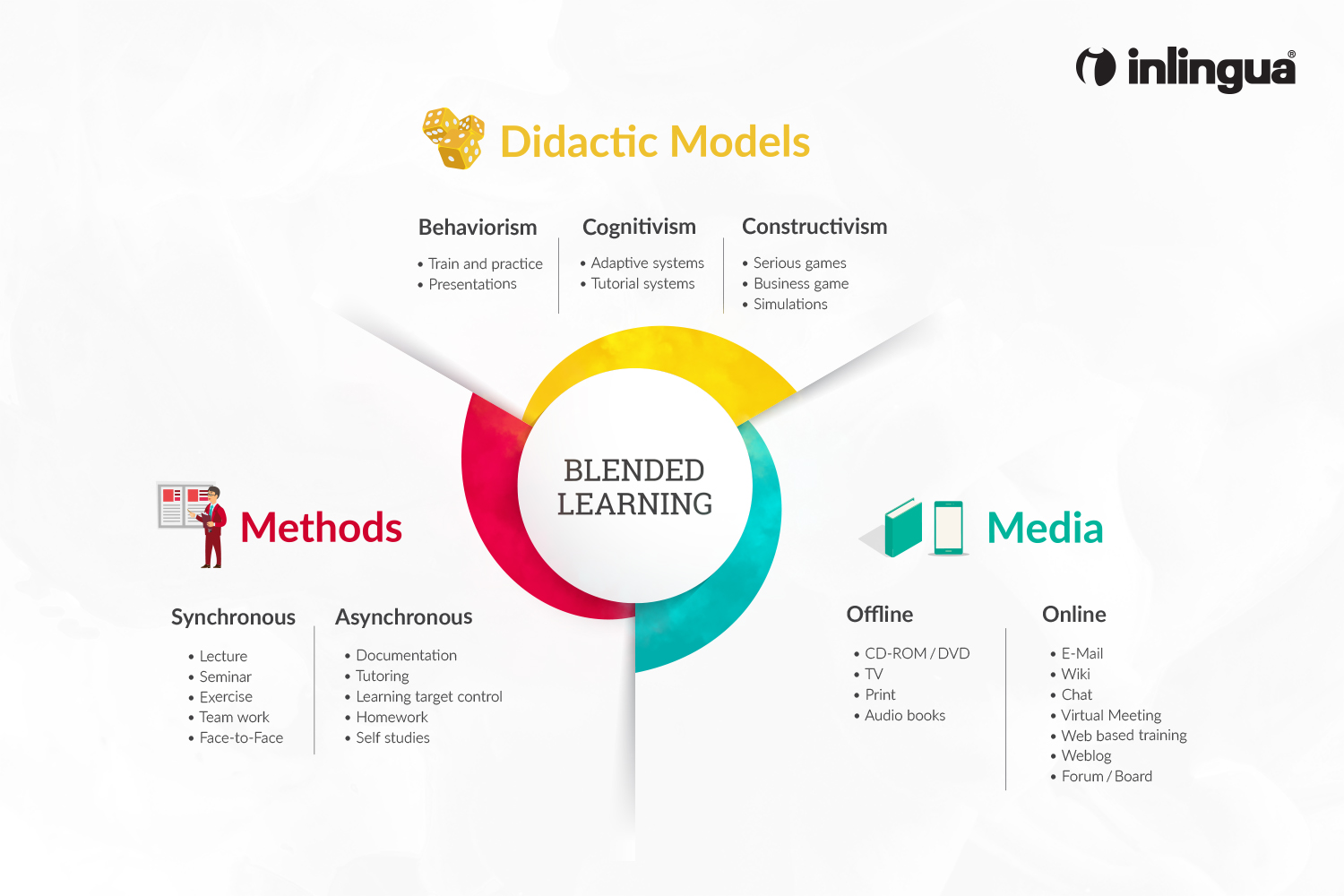
Claudia Wiepcke brought light into the darkness back in 2006 with her comprehensive overview, showing different aspects of didactic models, methods and media. A supplement and update were both provided in 2015 by Stefan Bieletzke.

Based on Claudia Wiepcke (2006) and Stefan Bieletzke (2015)

In blended learning scenarios, three forms of activity can be distinguished or combined with one another (cf. Alonso, López, Manrique & Viñes, 2007):

  • Self-directed e-learning: This is a setting, where learners can determine the time, intervals, pace and location of their learning activities themselves (“learning anytime and anywhere”).
  • Live e-learning: Synchronous forms of e-learning, for example lectures as webcasts or working in a virtual classroom at a fixed time. This enables learners to ask questions to the lecturers in real time or to exchange information with other course participants.
  • Traditional face-to-face teaching: Lectures, seminars, exercises, discussions and exchanges take place in the lecture hall, laboratory or seminar room and open up face-to-face interactions with teachers and fellow students.

There is disagreement about how much or how little online teaching belongs in the blend. Various authors agree that the percentage of online/offline content is not as important as the pedagogical design, timing and sequencing of activities to create a cohesive learning experience (Dziuban, Moskal & Hartman, 2005).

Thanks to a balanced mix of online and offline training, it is possible to take advantage of both methodologies, among which the following stand out:

Benefits for learners:

  • Blended learning offers the learner convenience and flexibility; they have the ability to control their learning pace and learn remotely.
  • Academic research suggests that through the use of more diverse means of information, blended learning gives learners a more comprehensive understanding of the course content.
  • Because blended learning allows learners to interact with instructors and fellow learners, social learning is supported.

Benefits for organizations:

  • Blended learning reduces face-to-face training costs, such as travel, accommodation, and printed training materials.
  • Companies can use varying eLearning methods, such as virtual classroom, online learning in LMS systems, gamification, etc., which result in increased learner engagement.
  • Because blended learning is a more efficient and cost-effective way to train, you’ll see a quicker and greater return on investment.
  • It’s also easier to track exactly who has, or hasn’t, completed training

Blended learning pitfalls:

Now that you know what blended learning is and we have piqued your curiosity, we would like to address some hurdles that need to be considered.

  • The most important pitfall you’ll need to avoid is using an LMS that doesn’t meet your needs. You’ll need an LMS suitable for language training to manage and deliver your blended learning strategy, including the integration of webinar/video conferencing software.
  • Keep in mind that what works for in-person training may not necessarily work for online training. You should not automatically assume existing courses are ready for online distribution. Analyze who your learners are, identify what they need to know, review your course content, and use this analysis to formulate a blended learning strategy.
  • If switching from exclusive face-to-face learning, take your time when incorporating blended learning into your learning strategy. Starting slow not only enables you to assess what is and is not working from a content perspective, but also gives your learners time to adapt gradually to the blended learning concept.
  • Of course, it’s important that blended learning isn’t used just for the sake of it. Once you have identified your learning goals, you can think about how each goal could be achieved in an online and/or offline setting.

By Christian Scheidegger, Pedagogical Manager, inlingua International Ltd.

Please click here, to consult further sources in German.


inlingua Plus offers a powerful tool that works with a fully integrated ZOOM or Webex host setting for Virtual Classroom. A vast variety of interactive online activities match the individual needs of your learners. Would you like to know more? Click here.

What is Blended Learning?

Blended learning is not a new concept. The term blended learning has been used in language teaching since before 2007, but the components of blended learning have changed radically as technology has progressed. The term blended learning generally refers to a combination of face-to-face teaching and online learning. If you consider a broader definition, the origins of blended learning could be traced back to the days when cassettes were available for home study along with coursebooks. In any case, an autonomous study element (usually electronic) is combined with face-to-face language training. Now inlingua has the facilities and experience to implement blended learning in different forms depending on the requirements of the learner or client. For an overview of blended learning models click here .

inlingua Plus

inlingua Plus is the name of inlingua’s blended learning offers. inlingua Plus has been designed to offer flexible blended learning programs to suit the needs of our clients and learners.

Blended Learning_inlingua Plus_Componentsinlingua Plus Components

Face-to-face

The face-to-face component of inlingua Plus is provided by experienced inlingua language trainers at the inlingua center near you. You can book the live sessions at times that are convenient for you. Alternatively, you can experience the teaching time in a virtual classroom situation or a combination of live and virtual lessons. Material can be provided in hard copies or in electronic form with the inlingua flex-e-book. The flex-e-book language app is available for Android and iOS-tablets, as well as Smartphones (NEW!).

inlingua Online Learning

iOL is inlingua’s online learning component. iOL comprises thousands of interactive written exercises in the main European languages with video and audio components and a virtual language lab for speaking practice. This component is used for home study and is available on personal computers, tablets and smartphones for easy access anywhere. The exercises can be set to align with the coursebook or customized to suit the needs of individual learners or groups. Tailor-made exercises can also be added to cover the specific needs of a company, group or individual. iOL has many additional features -check it out here.

Conversation Classes

This third component is an optional extra. Conversation classes are conducted on topics covered in the course attended. Learners can register for conversation classes and then book their own classes. This facilitates a further communication possibility with contact to other learners internationally in a virtual environment.

Flipped Classroom

inlingua Plus is designed to be trainer led (The Face-To-Face Driver Model) but a flipped classroom can also be organized with the online component preceding the face-to-face lesson at some centers.

How it WorksBlended Learning_inlingua Plus_How it Works

Corporate clients or individual learners contact the inlingua center to discuss their requirements. Some needs analysis and testing will be performed – inlingua has sophisticated online testing apps to check the level of each learner. Once the requirements have been agreed upon and a suitable blend agreed, the center administrator will set up access to the course for the learner(s). Help is offered by the local center and this is backed up by experts at the inlingua International Office in Bern, Switzerland. Progressive checks and periodical tests ensure progress is achieved. Reports can be generated on demand. Once a course has been completed and a language level attained, learners can continue seamlessly to the next course, if desired. Certificates of competence are issued by the inlingua center.

How it is Developed Blended Learning_inlingua Plus_How it is Developed

To develop an effective blended learning program, interaction including provision for online interaction with other learners, the language trainer, and possibly with other individuals in the wider world need to be provided. The blend should reflect the 12 second-language acquisition principles described by Thornbury.

inlingua provides task design and tools created and matched over the last 50 years of language teaching and learning experience. Materials, including technology-based material, are designed to provide content/input as well as facilitating learner progress. Technology-driven components have a clear link to face-to-face components (real or virtual) – with each complementing, supporting and developing the other.

Evaluation of technology-based work is integrated into overall learner evaluation. Our flexible approach to blended learning design takes into account the local context.

inlingua’s language trainers are trained to implement inlingua blended learning offers from inlingua Plus. Trainer training is initially given by the inlingua center, but also provided online by the inlingua Academy or staff at inlingua International.

Our electronically based material provides ease of revision which ensures our material is up-to-date and interesting for the learners.

Blended Learning_inlingua Plus_BenefitsThe Benefits of inlingua Plus

inlingua Plus promotes active learning as learners need to develop an element of autonomy to complete a course. It also allows learning to continue when schools close: online learning and some conversation courses can be accessed during non-office hours.

inlingua Plus presents pedagogical richness and opens access to knowledge while facilitating social interaction and personal agency. It offers cost-effectiveness for the learner and the inlingua center.

Criticism of Blended Learning

The main criticism of blended learning is whether the practice can provide learners with enough personal attention, guidance, and assistance from teachers.

For a further discussion on the advantages and disadvantages click here and here.

Next Blog Topic: Focus on the Virtual Classroom